
Outreach is available on paid plans only. Upgrade to access
How Outreach Works
Outreach analyzes all the citations AI models reference when responding to prompts about your industry (from the Citations feature). It then identifies: Existing Articles: High-authority articles that already influence AI conversations about your space, but don’t mention your brand. Getting included in these articles would immediately improve your AI visibility. New Articles: Article concepts that don’t exist yet but would fill gaps in AI model knowledge about your industry. These represent opportunities to pitch new content to relevant publications. For each opportunity, Outreach provides:- Pitch templates you can customize and send
- Expected impact on your AI visibility
- Step-by-step instructions for approaching the publication
- Verified contact information (when available)
Understanding Outreach Opportunities
Navigate between two main tabs to explore different opportunity types:- Existing Articles
- New Articles
Articles that already exist and influence AI conversations about your industry, but don’t currently mention your brand.Why these matter: These articles are already being cited by AI models. Getting your brand added to them provides immediate visibility in established, authoritative content that AI models trust.Your goal: Reach out to the publication or author to get your brand included in an update or revision of the article.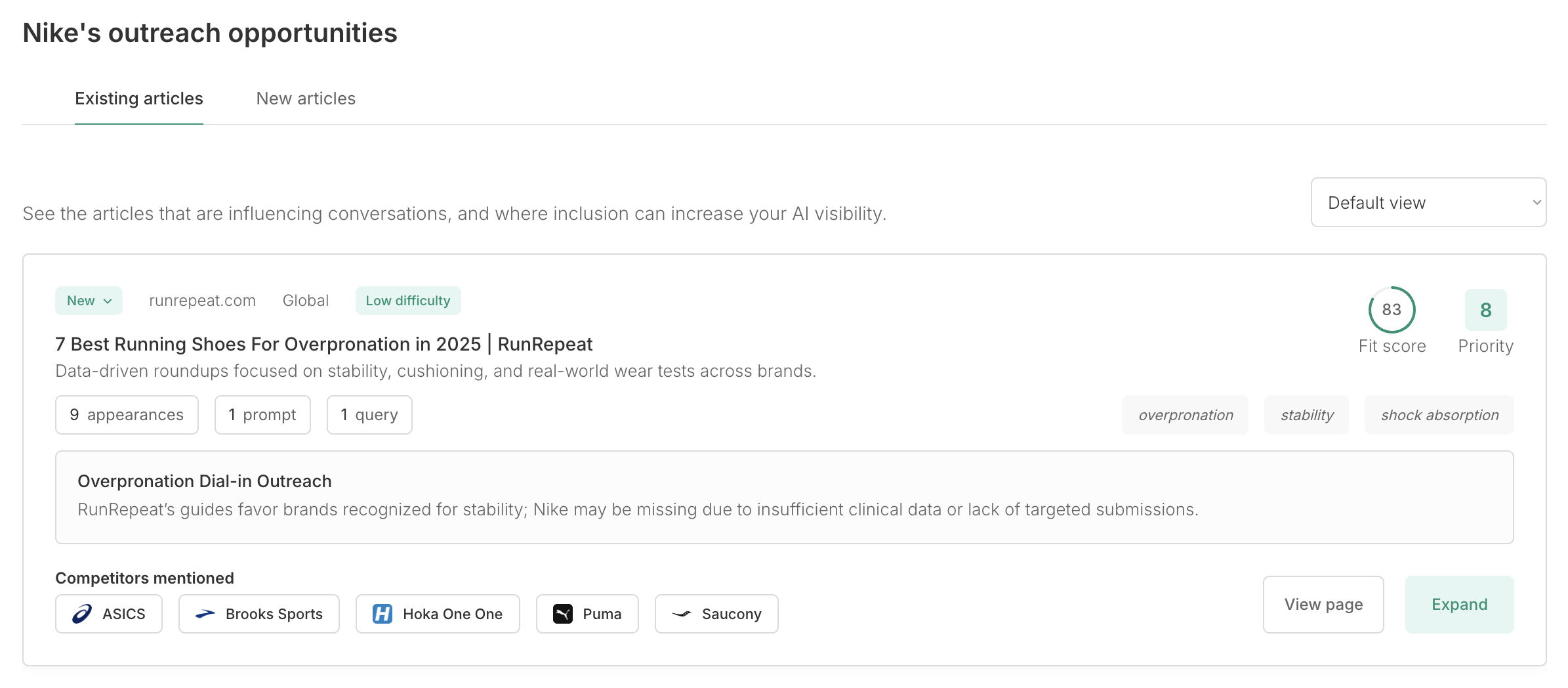
Opportunity Details
Each opportunity card shows key information to help you prioritize:| Element | Description |
|---|---|
| Status Badge | Current stage: New (just discovered), In Progress (you’re working on it), Won (successfully placed), or Hidden (not pursuing) |
| Domain | The publication where this opportunity exists or could be created |
| Scope | Geographic or market reach (Global, Regional, etc.) |
| Difficulty Badge | How challenging this opportunity is (Low/Medium/High difficulty) |
| Article Title | The existing article name or proposed article concept |
| Description | Brief summary of what the article covers and why it matters |
| Appearances | How many times AI models have referenced this article (existing articles only) |
| Prompts | Number of your tracked prompts that surfaced this article |
| Queries | Number of search queries AI models used that led to this article |
| Fit Score | How relevant this opportunity is to your brand and industry (0-100) |
| Priority | Overall importance ranking based on impact potential |
| Topic Tags | Key themes and subjects covered in the article |
Actions
View page: Opens the existing article in a new tab (existing articles only) Expand: Shows detailed outreach guidance including instructions, pitch template, and contact informationExpanding an Opportunity
Click “Expand” on any opportunity to see complete outreach guidance.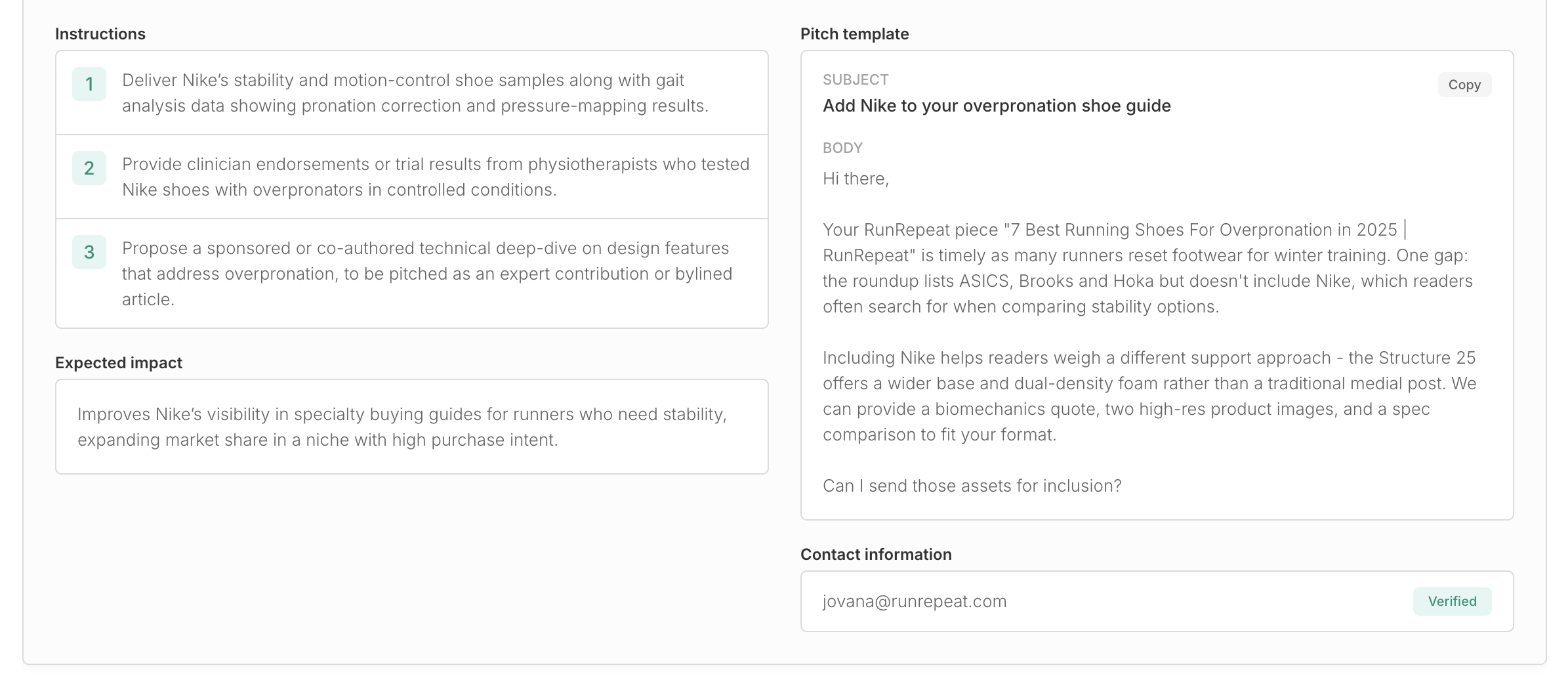
What You’ll See
Instructions Step-by-step guidance for approaching this specific opportunity:- What to prepare before reaching out
- How to position your brand or angle
- What materials or information to provide
- Specific actions to take for this publication type
- Requesting inclusion in an existing article update
- Pitching a brand-new article concept
- Providing expert commentary or data
- Offering product samples or testing opportunities
- Which searches or queries would surface your brand
- How this affects your competitive positioning
- What audience segments would see improved visibility
- Subject line: Attention-grabbing subject designed for this opportunity
- Body: Pre-written pitch you can personalize and send
- Copy button: One-click copying of the template
- Publication editors
- Article authors
- Relevant contacts at the domain
- Verified (green): Email confirmed as valid and deliverable
- Unknown (gray): Catch-all domain where we can’t verify individual addresses—we provide educated guesses based on common patterns
Not all opportunities have contact information. For opportunities without verified contacts, you’ll need to research the publication’s submission or contact process.
For New Article Opportunities
New article opportunities show additional context: New Article Pitch The proposed article title and angle that would fill a gap in AI model knowledge. Competitors Currently Winning Brands that currently dominate AI citations in this topic area—your competition if this article gets written without you. Brand Angle Suggested positioning for how your brand should be featured in the article.Managing Opportunities with Status
Track your outreach progress by updating opportunity status:New
Opportunities you haven’t acted on yet. Default status for all new opportunities.
In Progress
Opportunities you’re actively pursuing—reached out, waiting for response, in conversations, etc.
Won
Successfully placed opportunities where your brand is now mentioned or will be mentioned soon.
Hidden
Opportunities you’ve decided not to pursue. Removes from default view to reduce clutter.
Changing Status
Click the status badge on any opportunity card to open a dropdown menu with all status options. Select the new status to update.Filtering by Status
Use the “Default view” dropdown in the top right to filter opportunities:- Default view: Shows New and In Progress opportunities (your active pipeline)
- New Opportunities: Only shows brand new opportunities you haven’t acted on
- In Progress: Only shows opportunities you’re currently working
- Won: Shows your successful placements
- Hidden: Shows opportunities you’ve chosen to hide
Strategic Use of Outreach
Prioritize by Fit Score and Priority
Not all opportunities are equal. Focus first on:- High fit score (70+): Extremely relevant to your brand and industry
- High priority (7+): Significant impact potential
- Low difficulty: Easier to execute successfully
Start with Existing Articles
Existing articles often provide faster wins because:- The content already exists and is proven to influence AI models
- Authors may be receptive to updates with new information
- You can offer timely data, quotes, or corrections
- Articles already have traffic and authority
Target Low Difficulty Opportunities First
Low difficulty opportunities might include:- Publications you have existing relationships with
- Articles on topics where you have unique data or expertise
- Smaller, more accessible publications
- Opportunities where you can provide clear value (test results, expert commentary, etc.)
Batch Similar Opportunities
Group opportunities by:- Publication type (industry blogs, news sites, research publications, etc.)
- Topic or angle (product reviews, comparison guides, technical deep-dives, etc.)
- Required approach (data contributions, expert quotes, product samples, etc.)
Use Pitch Templates as Starting Points
The provided pitch templates are designed for each specific opportunity, but always:- Personalize with specific details about your brand’s unique angle
- Research the publication’s recent content and style
- Update with current information and timely hooks
- Customize the subject line to stand out in their inbox
Track Everything
Move opportunities through status stages:- New → In Progress: When you send your first outreach email
- In Progress → Won: When they agree to include you or publish your contribution
- In Progress → Hidden: When they decline or it’s not a good fit
- See what’s working and what’s not
- Avoid double-contacting the same opportunity
- Track success rates across different opportunity types
- Understand which approaches yield results
Best Practices
Don’t spray and pray Focus on 5-10 high-quality opportunities at a time rather than mass-emailing hundreds of publications. Personalized, thoughtful outreach converts better. Provide genuine value Publications want content that serves their readers. Frame your pitch around what you can contribute (data, expertise, unique perspective) rather than what you want (a mention, a link). Follow up strategically If you don’t hear back within a week, send one polite follow-up. If still no response, mark as Hidden and move on. Persistence is good; being annoying is not. Leverage existing relationships Prioritize publications where you have contacts, previous coverage, or warm introductions. These convert at much higher rates than cold outreach. Time your pitches Some opportunities are time-sensitive:- Seasonal content (gear guides, holiday roundups)
- News-driven articles (responding to industry changes)
- Annual updates (yearly “best of” lists)
- High-res product images
- Spec sheets or data points
- Executive bios and headshots
- Case studies or customer testimonials
- Technical details or testing data
- When the article goes live or gets updated
- Whether your brand is actually mentioned as expected
- If the article starts appearing in your Citations data
Understanding Difficulty Levels
Low Difficulty Opportunities where you have advantages:- Publications you’ve worked with before
- Topics where you have exclusive data or expertise
- Smaller, more accessible publications
- Clear value proposition for inclusion
- Mid-tier publications
- Topics with multiple valid expert sources
- Articles that would require moderate effort to update
- Publications with established but accessible processes
- Top-tier, highly selective publications
- Highly competitive topic areas
- Articles that would require significant rewrites
- Publications with very high barriers to entry
Connecting Outreach to Citations
Outreach opportunities come directly from your Citations data. This means: Every opportunity is proven: These articles are already influencing AI models—you’re not guessing what might work. Impact is measurable: After getting placed, watch for the article to appear in your Citations data with your brand mentioned. Priority is data-driven: Opportunities are ranked based on actual AI model behavior, not assumptions about what “should” matter. Topics are relevant: Since opportunities are based on prompts about your industry, they’re naturally aligned with what AI models need to know about your space. Think of Citations as showing you the problem (what influences AI models but doesn’t mention you) and Outreach as providing the solution (specific actions to get mentioned).Common Use Cases
Building Initial Authority
If you’re a newer brand with limited citations:- Focus on New Articles opportunities—get your brand into content being created from scratch
- Target smaller, accessible publications first to build a portfolio
- Offer unique data or testing results that publications can’t get elsewhere
- Use Won placements as social proof for approaching bigger publications
Competitive Displacement
If competitors dominate certain citations:- Find Existing Articles where competitors are mentioned but you’re not
- Offer updated information, newer data, or different perspectives
- Pitch New Articles that change the narrative in your favor
- Target articles that appear frequently in your most important prompts
Category Leadership
If you want to be the go-to authority:- Focus on high-fit, high-priority opportunities even if difficult
- Contribute to comprehensive guides and comparison articles
- Offer yourself as an expert source for quotes and commentary
- Create thought leadership content that publications want to reference
Seasonal or Campaign-Driven
For specific initiatives or launches:- Filter for opportunities related to your campaign topic
- Time outreach to coincide with product launches or announcements
- Offer exclusive information or early access
- Use timely news hooks to increase pitch relevance
Citations
Understand which sources influence AI models and where competitors get mentioned
Content Optimization
Optimize your own content to become more citation-worthy for AI models
Understanding Scores
Learn how citations and external mentions influence your visibility scores