
Content Optimization is available on paid plans only. Upgrade to access
Why Content Optimization Matters
AI models don’t just crawl your site—they need to understand it deeply enough to confidently cite it when answering user questions. Content Optimization reveals:- What AI models extract from your pages (entities, facts, metrics)
- How well you answer common questions in your space
- Where you’re missing citable snippets and structured information
- Specific content improvements that increase AI citation likelihood
- External opportunities to amplify your content’s reach
Getting Started
Starting a New Analysis
Navigate to Content Optimization and choose how you want to analyze your content: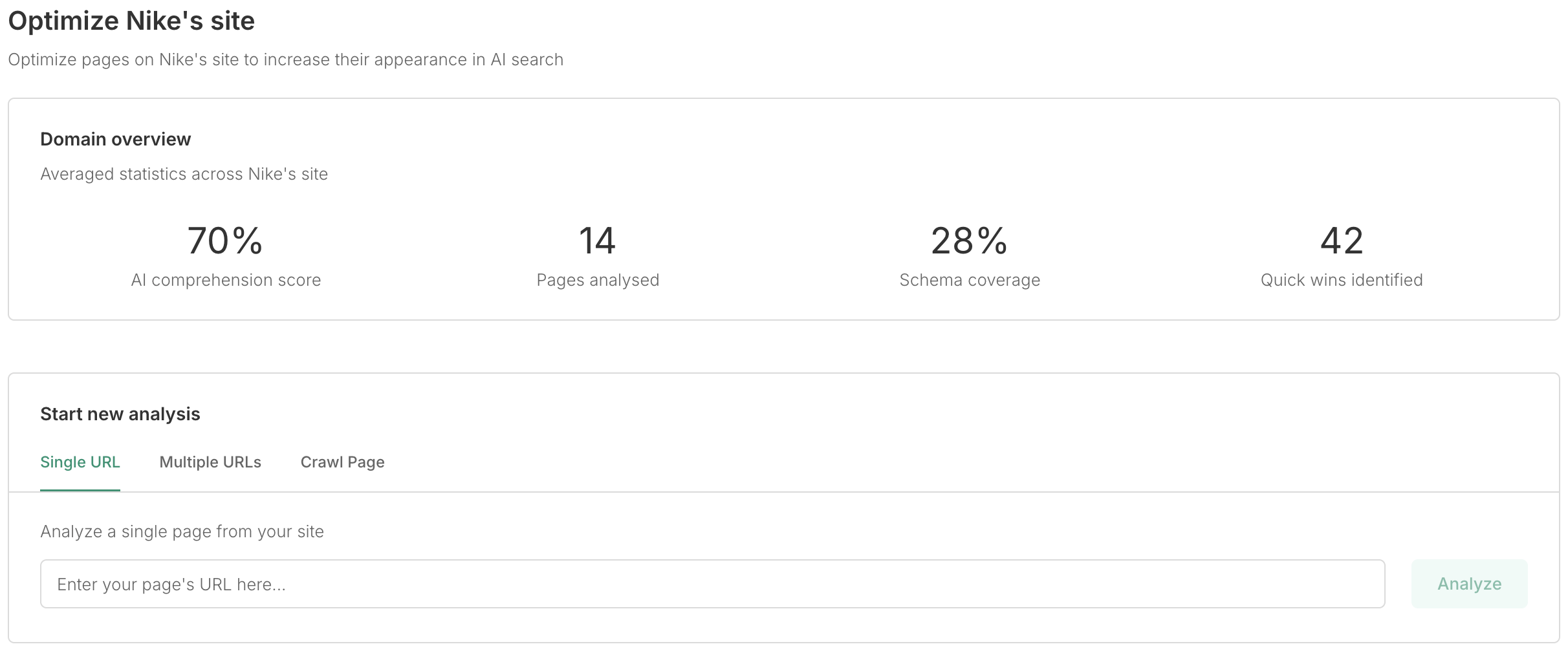
- Single URL
- Multiple URLs
- Crawl Page
Best for: Analyzing specific high-value pages individuallyHow it works: Deep analysis of one URLSetup:
- Enter the URL you want to analyze
- Click “Analyze”
- Results ready in 1-2 minutes
Understanding the Analysis Dashboard
After running analyses, you’ll see a domain overview with aggregated metrics across all analyzed pages:| Metric | What It Measures |
|---|---|
| AI Comprehension Score | Average score across all analyzed pages showing how well AI models can understand your content |
| Pages Analyzed | Total number of URLs you’ve run through Content Optimization |
| Schema Coverage | Average schema completeness across your analyzed pages—higher means better structured data |
| Quick Wins Identified | Number of high-priority, relatively easy improvements across all pages |
Viewing Individual Page Reports
In the “URLs analyzed” section, you’ll see all pages you’ve analyzed with:- URL: The page that was analyzed
- Score: AI comprehension score for that specific page
- Actions found: Number of improvement recommendations
- Date analyzed: When this analysis was run
- Actions: Delete the analysis or click “View report” to see full details
Understanding Your Content Report
Each page report contains comprehensive insights about how AI models perceive and can use your content.
Summary Metrics
At the top, you’ll see four key metrics for this specific page: Answer-First Score Measures how quickly and clearly your content answers likely questions. Higher scores indicate your content is structured to provide direct answers that AI models can easily extract and cite. Improvement Potential Shows how much opportunity exists to enhance this page for AI citations. Higher percentages indicate more room for optimization—think of this as your growth ceiling. Query Coverage The percentage of relevant queries that your page is well-equipped to answer. AI models simulate various questions people might ask about your topic and assess whether your content addresses them. Schema Coverage How complete your page’s structured data implementation is. Higher percentages mean AI models have better semantic understanding of your content through proper schema markup.Page Context
You’ll also see:- Page type: Auto-detected page category (Homepage, Product page, Blog post, etc.)
- User stage: Where users typically are in their journey when viewing this page
- Sophistication level: Content complexity assessment
Priority Actions
The Priority Actions section shows ranked recommendations for improving your content’s AI cite-ability.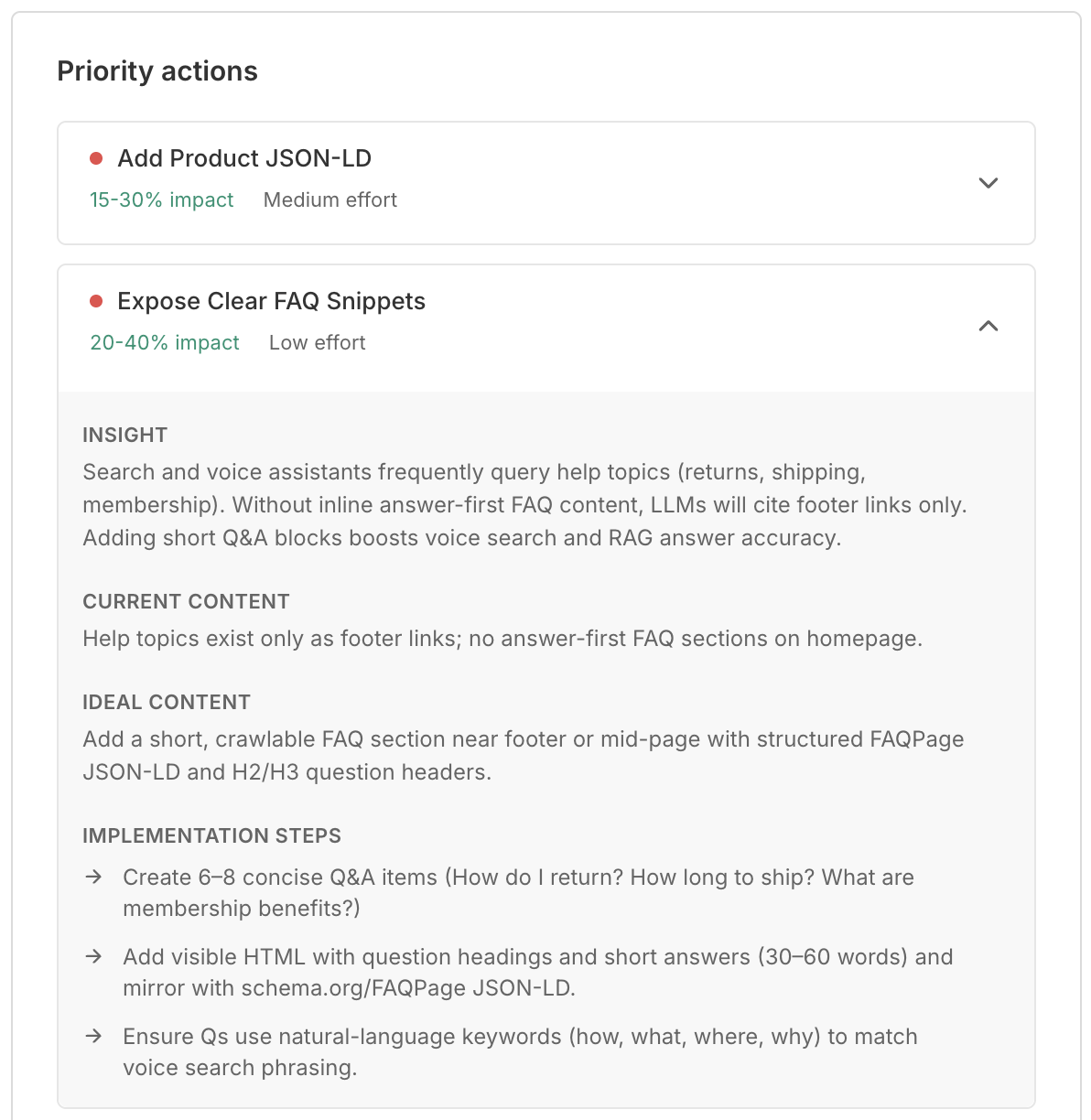
- Impact level: How much this change could improve AI understanding and citations
- Effort level: How difficult this is to implement (High/Low)
Common Action Types
Structured Data Improvements Adding or enhancing JSON-LD schema for products, articles, organizations, FAQs, etc. This gives AI models explicit semantic understanding of your content. Content Format Enhancements Restructuring content to be more answer-friendly—adding lists, tables, clear headings, FAQ sections, and explicit answers. Entity and Metric Addition Including specific data points, metrics, and entities that AI models look for when determining cite-ability and authority. Clarity and Specificity Replacing vague descriptors with concrete facts, adding missing information, and making implicit knowledge explicit.Citation Potential
The Citation Potential section shows how easily AI models can cite your content and what barriers might prevent them from doing so.
Citable Snippets
Green checkmarks indicate content elements that are already in citation-friendly formats:- Direct quotes or statements AI models can extract cleanly
- Well-structured facts with proper context
- Clear answers to specific questions
- Properly formatted data that’s easy to reference
Citation Barriers
Orange warnings indicate issues that make it harder for AI models to cite your content:- Vague language that lacks specificity
- Missing context or supporting data
- Important information buried in dense paragraphs
- Lack of structured formats (lists, tables, FAQs)
Missing Metrics
Click “View missing metrics” to see specific quantifiable data that AI models look for but couldn’t find on your page: Vague descriptors: Words like “best,” “curated,” “featured,” “new” that should be replaced with specific, measurable facts Missing metrics: Specific data points AI models prioritize when evaluating content authority and cite-ability (prices, quantities, ratings, timeframes, etc.) Quantification opportunities: Areas where you could add concrete numbers or data to strengthen your content Adding these metrics makes your content more authoritative and citation-worthy in AI model evaluations.Fact Density Score
Shows how rich your content is in concrete, citable facts versus general statements. Higher scores indicate more substance that AI models can extract and reference.Query Coverage
Query Coverage shows how well your page answers various types of questions AI models might encounter about your topic.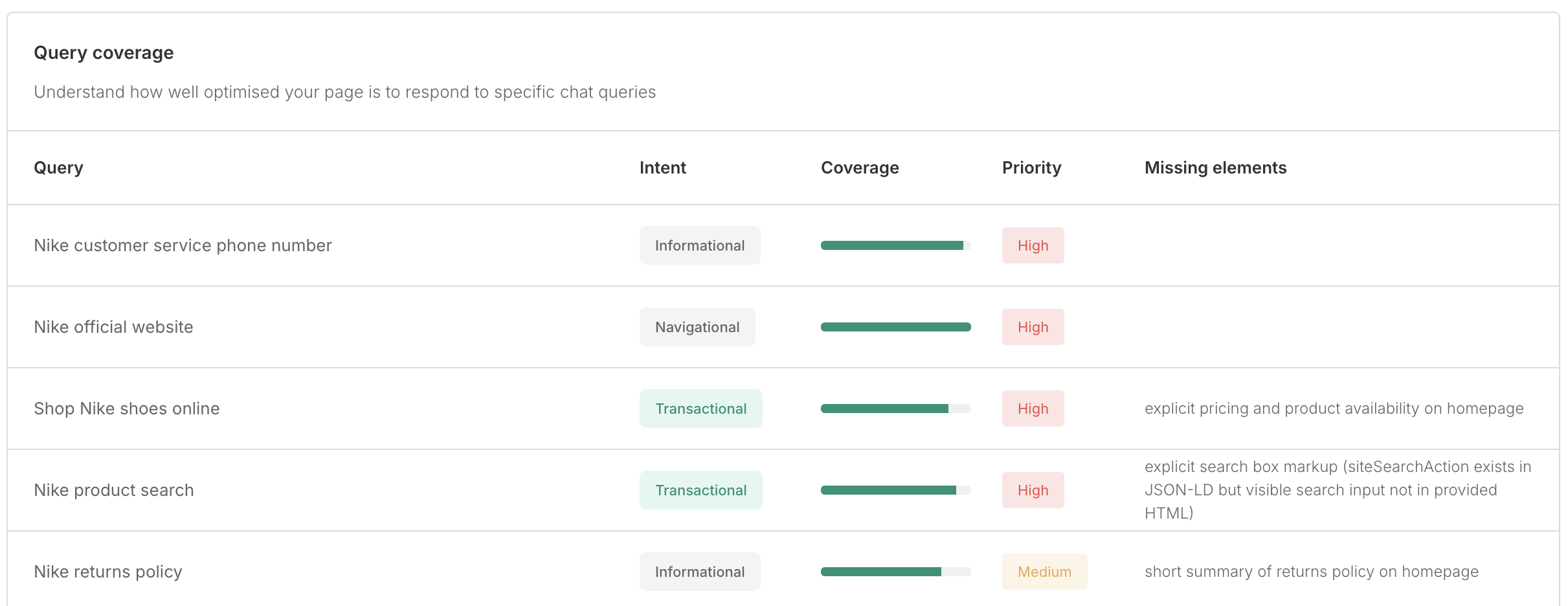
Understanding Query Simulations
Trakkr simulates relevant queries based on your page content—the kinds of questions real users ask AI models. For each query, you’ll see:| Column | Description |
|---|---|
| Query | The simulated question or search query |
| Intent | The type of question (Navigational, Informational, Transactional, Commercial) |
| Coverage | How well your page can answer this query (visualized with a progress bar) |
| Priority | How important this query type is (High/Medium/Low) |
| Missing Elements | Specific content needed to fully answer this query |
Query Intent Types
Navigational Queries where users are looking for a specific page or brand (e.g., “Company X official website”). High coverage means your page clearly identifies itself and provides expected navigation information. Informational Queries seeking knowledge or answers (e.g., “How does X work?”, “What is Y?”). High coverage means your content provides comprehensive answers to these questions. Transactional Queries indicating purchase intent (e.g., “Buy X”, “X pricing”). High coverage means transaction-related information is clear and accessible. Commercial Queries for product research and comparison (e.g., “Best X for Y”, “X vs Y”). High coverage means your page helps users make informed purchasing decisions.Improving Query Coverage
Focus on queries with:- Low coverage but High priority - These represent gaps in critical areas
- Missing elements that are easy to add - Quick wins that improve coverage
Entity Extraction
Entity Extraction shows what structured information AI models can successfully extract from your page—and how confident they are in that extraction.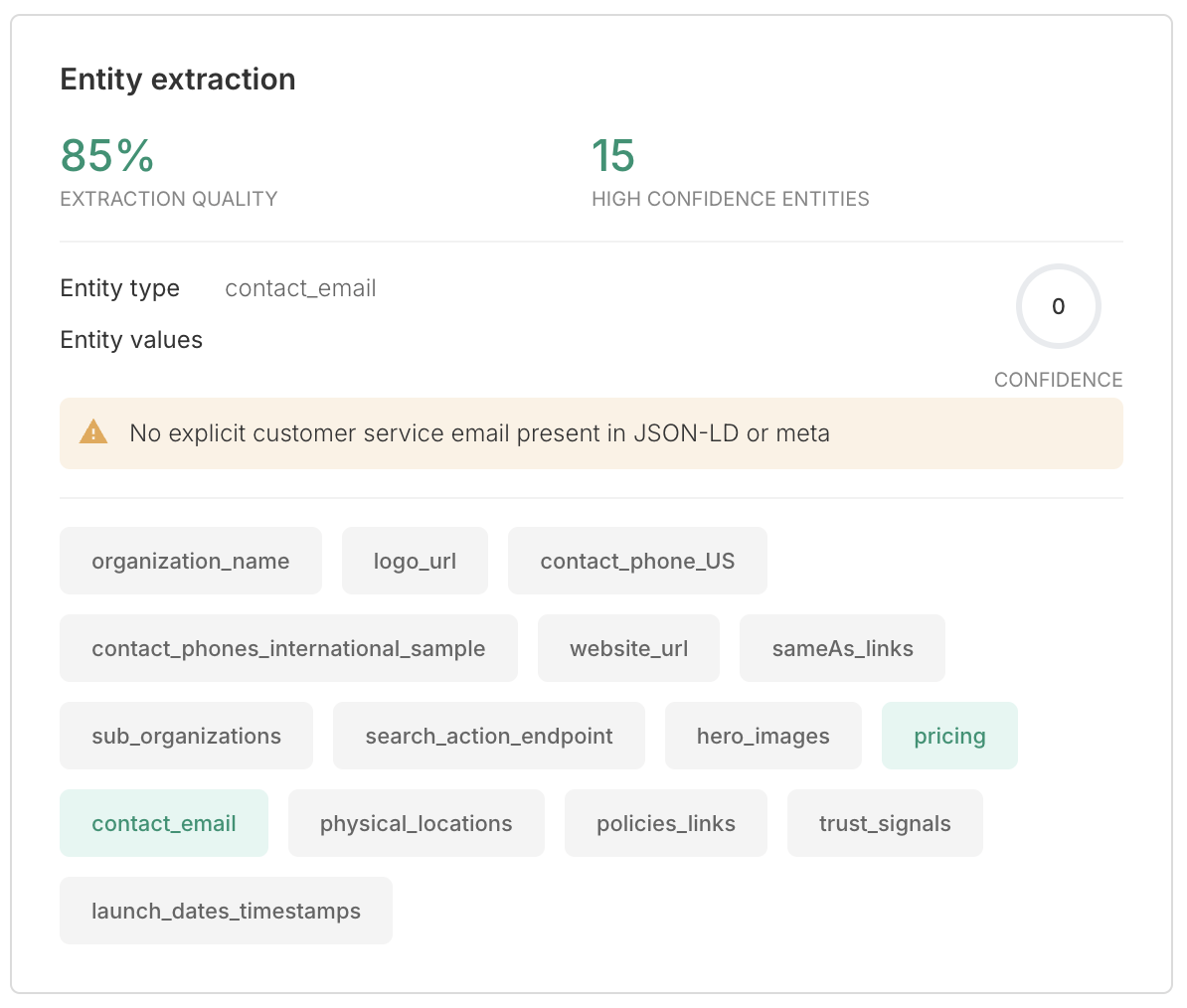
Extraction Metrics
Extraction Quality A score indicating how cleanly and accurately AI models can extract entities from your content. Higher scores mean your content is structured in ways that make extraction reliable. High Confidence Entities The number of entities AI models can extract with high confidence. These are facts, data points, and structured information that models trust and can cite.Extracted Entities
The report shows specific entities found on your page, grouped by type:- Entity type: The category of information (product_prices, company_name, contact_information, etc.)
- Entity values: The actual data extracted
- Confidence score: How certain the AI model is about this extraction
- Product prices and specifications
- Company information
- Contact details
- Location data
- Payment methods supported
- Product inventory indicators
- Review and rating data
- And many more depending on your page content
Warning Signs
Orange warning boxes indicate extraction issues:- Implicit information that should be made explicit
- Missing structured data that would improve extraction
- Ambiguous formatting that reduces confidence
- Context gaps that make extraction unreliable
The entities shown are based on your specific page content and type. Product pages show different entities than blog posts or service pages.
External Opportunities
External Opportunities suggests platforms and content angles for promoting your page externally, which can boost citations and authority signals for AI models.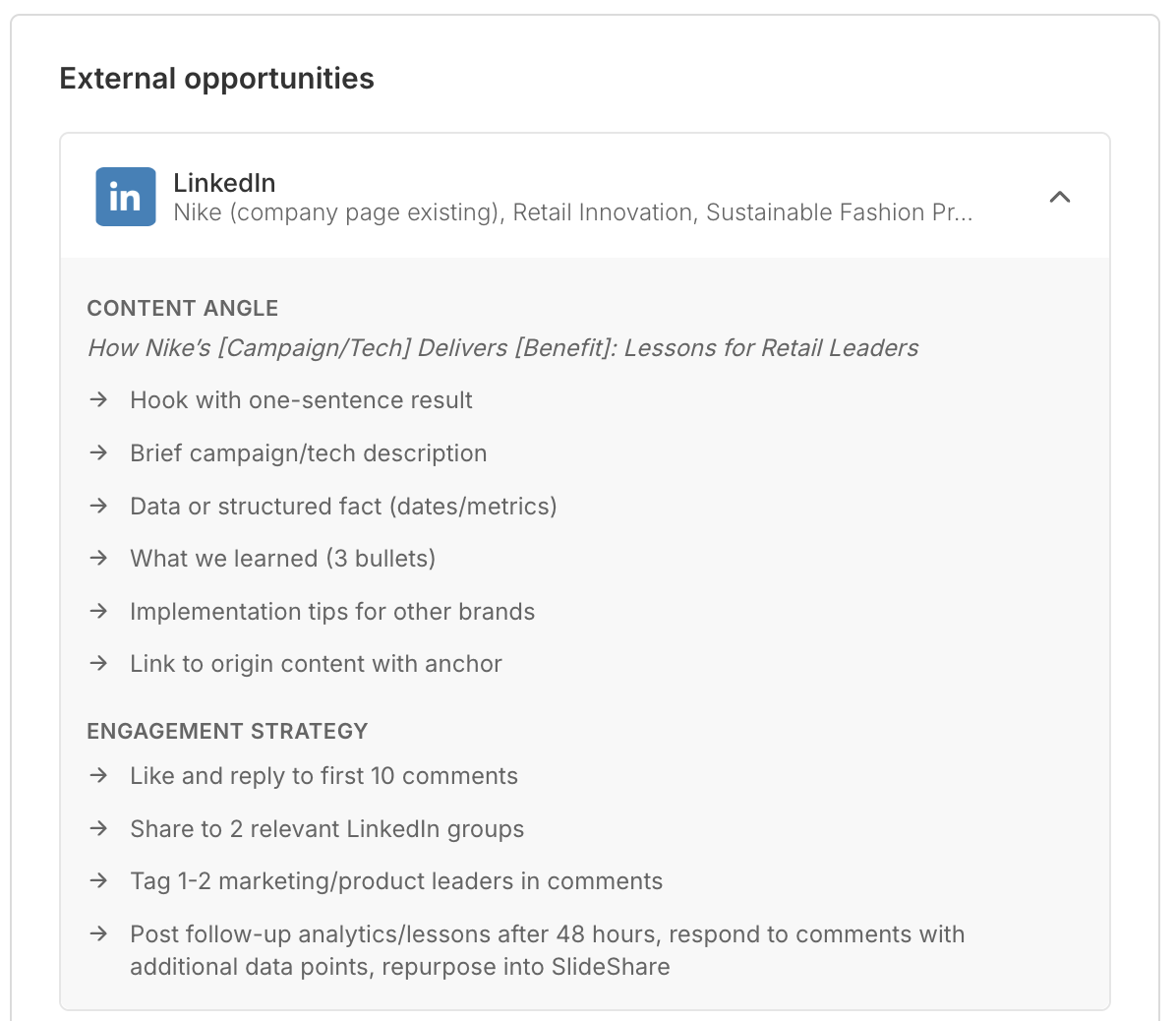
Platform Suggestions
Based on your page content and industry, Trakkr suggests relevant external platforms where your content could gain visibility:- Social platforms (LinkedIn, Twitter, etc.)
- Community sites (Product Hunt, Medium, Reddit, etc.)
- Industry-specific platforms relevant to your niche
- Types of content to post
- How to structure the message
- Engagement approaches that work well
- Follow-up strategies
Why External Promotion Matters
When your content appears on high-authority external sites:- AI models discover it through citations and links from trusted sources
- Authority signals increase as multiple reputable sites reference your content
- Citation likelihood improves because models see your content validated by external sources
- Broader discovery means more opportunities for AI models to encounter and cite your work
Using Content Optimization Strategically
Start with High-Value Pages
Don’t try to optimize every page at once. Focus on:- Homepage - Your primary brand introduction
- Top landing pages - Pages that drive traffic or conversions
- Key product/service pages - Your main offerings
- Popular blog posts - Content that already gets traction
Prioritize Actions by Impact and Effort
Within each page report, focus on:- High impact + Low effort first - Quick wins with meaningful results
- High impact + High effort second - Significant improvements worth the investment
- Low impact actions last - Only if you’ve handled higher priorities
Balance Quick Wins with Deep Work
Quick wins might be:- Adding specific metrics to replace vague language
- Formatting existing content into lists or tables
- Adding FAQ sections with questions you already answer
- Implementing basic schema markup
- Creating comprehensive content to fill major query coverage gaps
- Extensive structured data implementation
- Rewriting sections for clarity and cite-ability
- Developing entirely new content types (comparison tables, detailed guides, etc.)
Integrate with Technical Audit
For best results, use both tools together:- Run Technical Audit first to fix crawlability, rendering, and technical SEO issues
- Then run Content Optimization to improve what AI models understand once they can access your content
- Technical Audit ensures AI models can find and read your pages
- Content Optimization ensures they understand and cite what they find
Track Your Improvements
While individual analysis scores aren’t tracked over time, you can:- Run analysis before implementing changes, save results
- Implement recommended actions
- Run analysis again on the same pages
- Compare scores and improvements manually
Best Practices
Don’t optimize in a vacuum Look at query coverage to understand what questions users actually ask, then optimize to answer those questions—not arbitrary improvements. Combine actions when possible Many improvements overlap. For example, adding structured data often addresses multiple actions at once (entity extraction, schema coverage, citable snippets). Make content explicit AI models can’t infer or “read between the lines” as well as humans. Make your expertise, data, and answers explicit and direct. Add concrete metrics Replace vague language (“fast delivery,” “competitive pricing”) with specifics (“2-day shipping,” “$49.99 starting price”). AI models strongly prefer concrete facts. Structure for extraction Use lists, tables, clear headings, and FAQ formats. These make it easy for AI models to extract and cite specific information. Test your changes After implementing improvements, run Content Optimization again to see if your scores improve and actions are resolved. Focus on answer-first structure Especially for informational content, lead with direct answers then provide supporting details. AI models look for this pattern when deciding what to cite.Common Use Cases
E-commerce Product Pages
Priority improvements:- Add Product schema with prices, availability, ratings
- Include specific product metrics (dimensions, materials, specifications)
- Add FAQ section covering common product questions
- Structure comparison data in tables
- Include customer review aggregates with schema
Service Pages
Priority improvements:- Add Service schema with pricing, service area
- Create clear process explanations with numbered steps
- Include specific timelines and deliverables
- Add FAQs about your service offering
- Make contact and booking information explicit
Blog Posts & Articles
Priority improvements:- Add Article schema with author, publish date, content type
- Structure content with clear H2/H3 hierarchy
- Lead with direct answers to questions
- Include specific data, statistics, and sources
- Format key takeaways as lists or callout sections
- Add related question FAQs at the end
Landing Pages
Priority improvements:- Add relevant schema for the page type
- Include clear value propositions with metrics
- Structure benefits as scannable lists
- Add social proof with specific numbers
- Make CTAs and next steps explicit
- Cover common objections in FAQ format
Technical Audit
Fix technical barriers preventing AI models from accessing your content
Citations
See which external sources are citing your content and influencing AI models
External Opportunities
Identify high-value platforms and partnerships to amplify your content reach